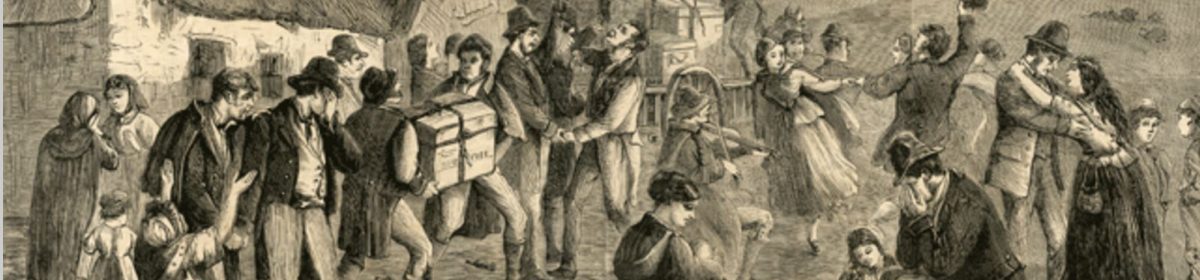
This story is built from what survives: death certificates, baptismal records, city directories, census records, and newspaper articles. Where the documents speak, I listen. Where they fall silent, I reconstruct what I can from the patterns of Irish immigrant life in nineteenth-century New York and Dublin. What follows is both history and imagination, both fact and inference—an attempt to resurrect human lives from archival fragments.
December 19, 1820 – New York City
The coffin was small. That’s what struck the people watching the funeral procession move slowly down Gold Street toward the cemetery. Not the December cold, though it cut through every layer of the wool clothes the mourners wore to keep it away. Not the father’s face, though Philip Heenan looked ashen and broken, decades older than his thirty-six years. The coffin. William’s coffin, barely longer than his father’s outstretched arms.
He had turned twelve in the autumn. Dark-haired like his father, quick with numbers, the one who could make his mother laugh even when money was tight. The fever took him in less than a week. One day, he complained of a headache. Six days later, his fever was gone, and his body lay still and cold. Sarah washed him one last time, remembering when she bathed him as a child. That other life, that other bright and endless life.
It was Tuesday afternoon, two o’clock. Cold enough that breath hung in the air like smoke. The family gathered outside number 29—Sarah rigid and silent, Ellen pressed close to her mother’s side, the boys trying to stand like men and failing.
Philip, Martin, and John Michael stood with their father. They were old enough to understand death, young enough to be shattered by it. Philip was trying to hold himself together the way he’d seen other men do at funerals. Martin’s hands were clenched so tight his knuckles had gone white. John Michael kept looking at the coffin and then looking away, as if looking away could make it not real.
But Willie was dead. And grief cracked through their composure like ice breaking.
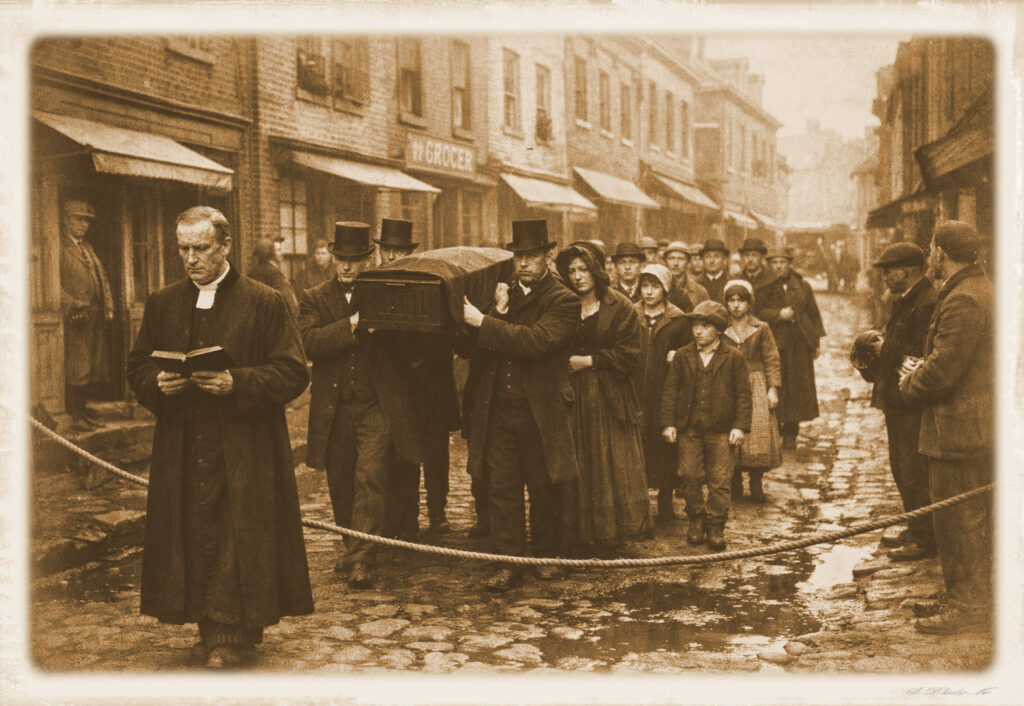
The neighbors came. More than Philip expected—forty, fifty people, forming a line that stretched down Gold Street. Irish Catholics from the surrounding blocks, women who knew Sarah from church, men who worked alongside Philip or bought his ironwork or simply understood what it meant to bury a child in this city. They came because that’s what you did. They came because someday it might be their child in the coffin, and they would need Philip Heenan to walk behind it.
Someone began the prayers. The procession started moving.
Philip walked directly behind the coffin. His hands, blacksmith’s hands, scarred from forge work and strong enough to shape iron, hung useless at his sides. What good were strong hands? What had he built that mattered if he couldn’t keep his son alive?
They walked slowly through the narrow streets. Funeral pace. The kind of walking that leaves too much room for thought. Philip’s mind went to places he didn’t want it to go—to Ireland, to the crossing, to the thousand small decisions that had brought them here. To the weighing of one life against another, and the hope that leaving Dublin would give them better lives. To his son’s hands, learning the weight of a hammer. To the boy reading, or laughing, or running with his brothers. To ordinary moments he’d thought would last forever. To William, who was all of those moments, and now was none. To William. To William.
Sarah walked behind, eyes fixed, staring at a future she did not want to face. Ellen held her arm, afraid her mother might simply stop walking and stand there in the street forever. The girl had washed her brother’s body. She had seen death before, of course, but not like this. Not her little brother. Not Willie.
The cemetery gate appeared ahead. Michael O’Connor stood waiting, the sexton, another Irishman in a city full of them. The grave was ready. St. Patrick’s Cemetery, the Catholic ground, the place where Irish families buried their dead when they couldn’t take them home.
Home. Dublin was home once. A place where Philip’s family had lived for generations, where Sarah’s people were rooted, where the children had been born into something that made sense. But you couldn’t go back with American children and empty pockets. Home was here now, whether they’d chosen well or not. These streets. This city. This frozen ground was home now.
They lowered the coffin into the earth.
Sarah made a sound—not a cry, just a small broken noise escaping from the part of her that had died with Willie. Ellen tightened her grip on her mother’s arm. The boys stood frozen. The prayers continued, Latin words washing over them like water, meaning nothing, and everything.
And then it was done.
The mourners began to leave, one by one, touching Philip’s shoulder as they passed. Words of comfort, barely heard. Promises to stop by the house. The slow unwinding of community back into individual lives and troubles.
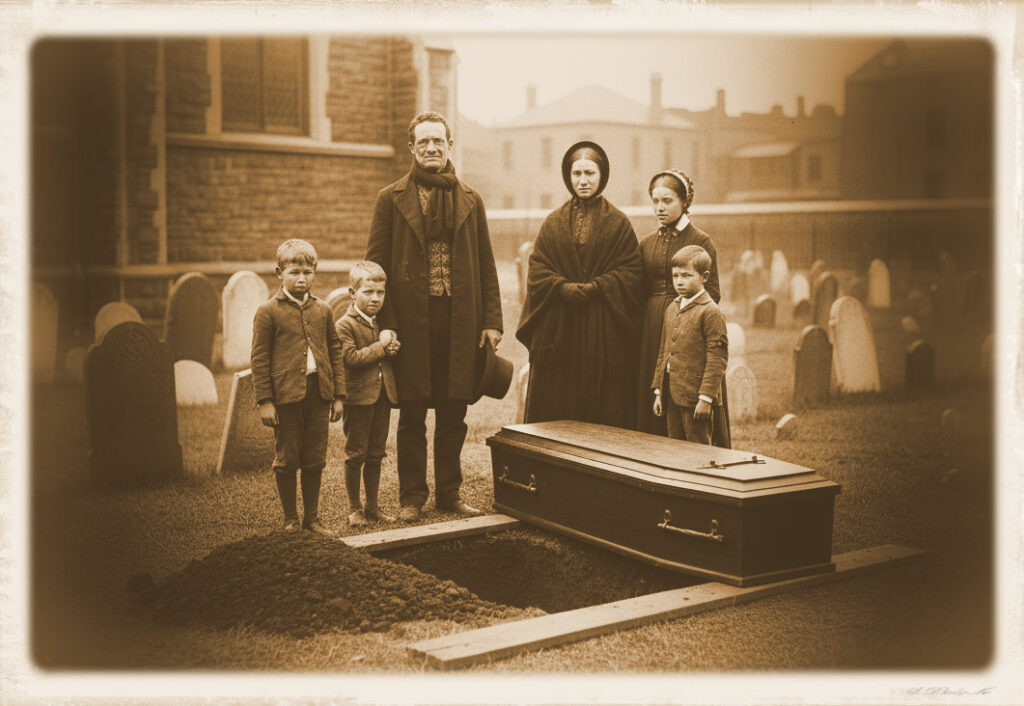
The family stood there longer. No one wanted to be the first to turn away, to leave William there alone in the frozen ground. The rooms they shared on Gold Street would feel different now—too quiet and too crowded at once, Willie’s absence everywhere. His voice, missing from the supper table. His pallet on the floor, empty. The space he’d occupied in their small, jumbled, cramped life, now a hole in the world that nothing would fill.
Philip looked at Sarah. She looked back. There was nothing to say. They had crossed an ocean to give their children better lives. They had worked and sacrificed and built something from nothing. They had done everything they knew how to do. And Willie was still dead. He was twelve years old, and the earth was frozen, and New York didn’t care.
There was tomorrow and the day after and all the days of their lives stretching forward without Willie in them. They turned and walked back toward the city.
Continued: Dublin

One thought on “The Blacksmith’s Son”